
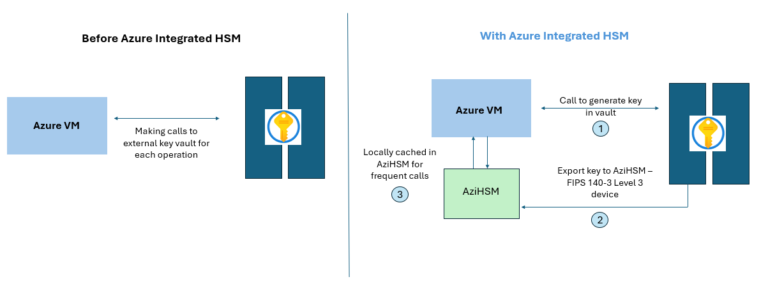
Azure Integrated Hardware Security Module, (HSM), is Microsoft’s built-in hardware security capability for cryptographic operations on supported virtual machines. It combines a hardware security module cache and crypto offload engine so keys can stay inside tamper-resistant hardware while cryptographic operations run with lower latency than traditional network-based HSM patterns.
What is HSM?
A HSM is a special security device that stores and uses encryption keys safely. It keeps those keys inside protected hardware, so they are not easily seen or copied by software, memory dumps, or people with server access.
Azure Integrated HSM brings that concept closer to the workload by embedding Microsoft-designed HSM chips directly into supported Azure server hardware. Microsoft states that these chips meet FIPS 140-3 Level 3 standards, which is important for organizations that need strong assurance around key protection and tamper resistance.
What is FIPS 140-3 Level 3 standard?
In simple words, it is a higher-security standard for encryption hardware so that keys are much harder to steal or misuse.
Think of it like this:
Level 1 = basic protection.
Level 2 = adds tamper evidence.
Level 3 = adds strong physical protection and identity-based access.
Level 4 = the toughest level, for extreme attack resistance.
So for Azure Integrated HSM, saying it is FIPS 140-3 Level 3 means the hardware is designed to keep cryptographic keys very well protected, even if someone has physical access to the device.
Use Case.
Azure Integrated HSM is especially relevant for organizations that depend heavily on cryptography and run performance-sensitive workloads. This includes sectors such as financial services, healthcare, government, payment platforms, and enterprise applications handling sensitive or regulated data.
General Availability.
Microsoft announced the general availability of Azure Integrated HSM in May 2026. According to Microsoft Learn, the feature is generally available on the AMD v7 platform in all AMD v7 supported regions, and it is supported on Dasv7-series, Dadsv7-series, Easv7-series, and Eadsv7-series virtual machines with 8 vCores or higher when using Trusted Launch VMs.
The current general availability scope is Windows support only, with Linux support expected later. Microsoft also states that Azure Integrated HSM is offered at no extra cost on supported infrastructure.
Benifits.
- Lower latency, because cryptographic operations can be performed locally instead of sending requests to a remote HSM or key service.
- Stronger key protection, because keys remain inside a FIPS 140-3 Level 3 hardware boundary and are not exposed in clear text during use.
- Better protection against memory and crash-dump attacks, since sensitive key material stays within dedicated hardware rather than normal system memory.
- Built-in infrastructure, because the HSM capability is attached to supported Azure nodes as part of the platform rather than deployed as a separate appliance.
- No additional charge on supported platforms, which lowers the barrier for adoption compared with some traditional HSM deployment models.
Reference.
- https://techcommunity.microsoft.com/blog/azurecompute/announcing-the-general-availability-of-azure-integrated-hardware-security-module/4517103
- https://learn.microsoft.com/en-us/azure/security/fundamentals/how-to-deploy-azure-integrated-hardware-security-module
