The role of the operational database is changing. As organizations rush to embed Artificial Intelligence into their applications, the database layer is no longer just a static system of record—it needs to act as the active intelligence hub for Retrieval-Augmented Generation (RAG) pipelines, semantic search, and real-time machine learning workflows.
Azure HorizonDB (Preview).
Microsoft has just launched a massive evolution in its database portfolio. HorizonDB is a cloud-native, fully managed PostgreSQL database engineered specifically for mission-critical scale and AI-driven applications. If you are an architect wondering whether you should use this new service or stick with Azure Database for PostgreSQL – Flexible Server, you are in the right place.
What is Azure HorizonDB?
Azure HorizonDB is Microsoft’s next-generation managed PostgreSQL service. It is designed to bring transactional data, cloud-native scale, and AI capabilities into a single, unified platform.Instead of forcing developers to stitch together separate systems for relational data, vector search, AI model management, and analytical data pipelines, HorizonDB supports all these patterns directly within a 100% PostgreSQL-compatible ecosystem.
The PostgreSQL License & Compatibility.
Because HorizonDB is built on community PostgreSQL (currently supporting version 17 in preview), it retains full open-source compatibility. You do not have to learn a proprietary language or worry about vendor lock-in. Your existing Postgres extensions, tooling (like PgBouncer), and development frameworks will work out of the box.
The Core Architecture: Why is it so fast?
The secret to HorizonDB’s massive performance gains lies in two foundational architectural shifts:
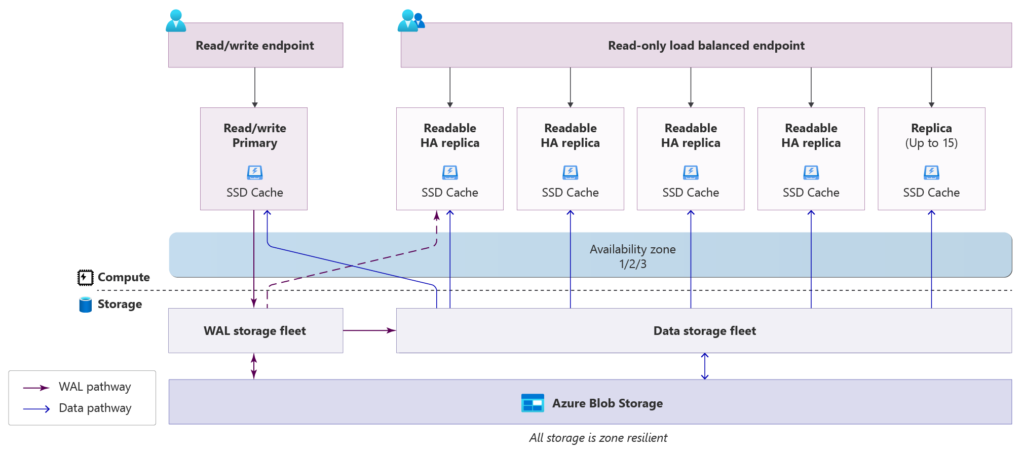
Dis-aggregated Compute and Storage
In traditional Postgres setups, compute and storage are tightly coupled to a single virtual machine. HorizonDB completely separates the compute layer from the storage layer. This means you can scale your compute (CPU/RAM) completely independently of your storage capacity based on demand, avoiding costly over-provisioning.
Database-as-a-Log Design
Traditional PostgreSQL architectures require multiple coordination steps and checkpoints to commit transactions, which creates I/O bottlenecks. HorizonDB utilizes a Database-as-a-Log architecture.
- The Write-Ahead Log (WAL) acts as the authoritative source of truth.
- Transactions commit in a single step to shared storage.
- Storage nodes reconstruct the page state by applying the WAL, drastically reducing write amplification and coordination overhead.
The result? Predictable, ultra-low write latency regardless of how large your database grows.
Scale, Performance, & Resilience.
For mission-critical applications (like payment processing, multi-tenant SaaS platforms, or e-commerce backends), HorizonDB operates at a scale that standard VMs simply cannot reach.
- Massive Scale-Out: Auto-scale your storage dynamically from kilobytes up to 128 TB. On the compute side, you can scale out to a staggering 3,072 vCores distributed across primary and read-replica (max 15 replicas) nodes.
- Extreme Performance: Thanks to the log-based architecture, HorizonDB delivers up to 3x faster transactional performance compared to self-managed PostgreSQL.
- Built-in Resilience: High Availability (HA) is not an afterthought. HorizonDB provides default multi-zone replication, ensuring fast failover and continuous uptime for always-on applications.
AI-Empowerment Built-In
Microsoft has engineered HorizonDB to be the ultimate backend for modern AI applications. It eliminates the need to push data out to external vector databases.
- Advanced Vector Search: While standard Postgres uses
pgvector, HorizonDB supercharges this by integrating DiskANN vector search. This enables high-speed, advanced filtered vector searches natively within the database, drastically lowering costs and improving RAG pipeline performance. - Azure AI Foundry Integration: Developers can manage pre-provisioned AI models and invoke AI functions directly from Postgres SQL queries without external orchestration.
- Zero-ETL to Microsoft Fabric: Need analytics? HorizonDB supports zero-ETL mirroring, allowing you to seamlessly sync your transactional data straight to Microsoft Fabric OneLake without building complex data pipelines.
Enterprise-Grade Security.
Organizations need robust security for sensitive cloud data, and HorizonDB is enterprise-ready from day one. It includes:
- Network Isolation: Full support for VNet integration and Private Endpoints.
- Identity Management: Native integration with Microsoft Entra ID for seamless, passwordless authentication and centralized authorization.
- Data Protection: Data is encrypted at rest by default (Customer-Managed Keys are on the roadmap for General Availability).
Head-to-Head: HorizonDB vs. Flexible Server.
The biggest question architects have right now is: “Should I use Flexible Server or HorizonDB?”Here is the simplified decision matrix to help you choose the right tool for the job.
| Feature | Azure Database for Postgres (Flexible Server) | Azure HorizonDB |
| Best Fit For | Standard web apps, dev/test, predictable standard workloads. | Mission-critical apps, massive scale SaaS, AI/RAG apps. |
| Architecture | Single managed VM (Compute & Storage coupled). | Cloud-native, Disaggregated Compute & Storage. |
| Max Compute Scale | Up to 96 vCPUs (Memory-optimized VM). | Up to 3,072 vCores (across cluster). |
| Max Storage Scale | Up to 32 TB. | Up to 128 TB (auto-scaling). |
| Performance Design | Traditional Postgres Checkpoint I/O. | Database-as-a-Log (Single-step WAL commits). |
| AI Capabilities | Standard pgvector & Azure AI extension. | High-speed DiskANN, AI Foundry, Zero-ETL to Fabric. |
| Cost Model | Burstable, General Purpose, or Memory Optimized tiers. | Pay-as-you-go per vCore; independent storage billing. |
The Architect’s Rule of Thumb:
If your application can comfortably run on a single virtual machine and you are looking to optimize standard costs, stick with Flexible Server. However, if you require extreme read scale-out, storage beyond 32 TB, the absolute fastest failover times, or you are building an AI-native application heavily reliant on vector search, HorizonDB is your new standard.
Summary Verdict.
Azure HorizonDB signals exactly where Microsoft is taking the database ecosystem. By separating compute from storage and treating the database layer as an active participant in AI pipelines, they have solved the biggest scaling and performance headaches associated with open-source PostgreSQL.
Note: Azure HorizonDB is currently in Public Preview. While it is an incredible architectural leap forward, evaluate regional availability and preview SLAs carefully before migrating production workloads.
Reference.
https://azure.microsoft.com/en-us/pricing/details/horizondb