For years, the traditional Hub-and-Spoke network topology has been the undisputed foundation of Azure enterprise architecture. It provides a centralized point for workloads and branches to connect through, typically funneling traffic through a firewall.
However, as organizations scale multi-region footprints and integrate massive SD-WAN branch networks, the manual overhead of managing this topology begins to buckle.
Enter Azure Virtual WAN (vWAN). Is it a replacement for Hub-and-Spoke, or a completely different paradigm?
The Breaking Point of Traditional Hub & Spoke
In a traditional hub-and-spoke architecture, you build and operate the central VNet yourself. Because Azure virtual network peering is non-transitive by default, a spoke cannot natively reach another spoke.
To force traffic through a central Azure Firewall or Network Virtual Appliance (NVA), cloud engineers must rely on User-Defined Routes (UDRs).
- The Scale Problem: Every new spoke requires new UDRs on every subnet to ensure traffic routes correctly.
- The Multi-Region Problem: If you expand to a second or third Azure region, you must manually peer the hubs and synchronize route tables across regions, creating a brittle web of static configurations.
The Azure Virtual WAN Paradigm
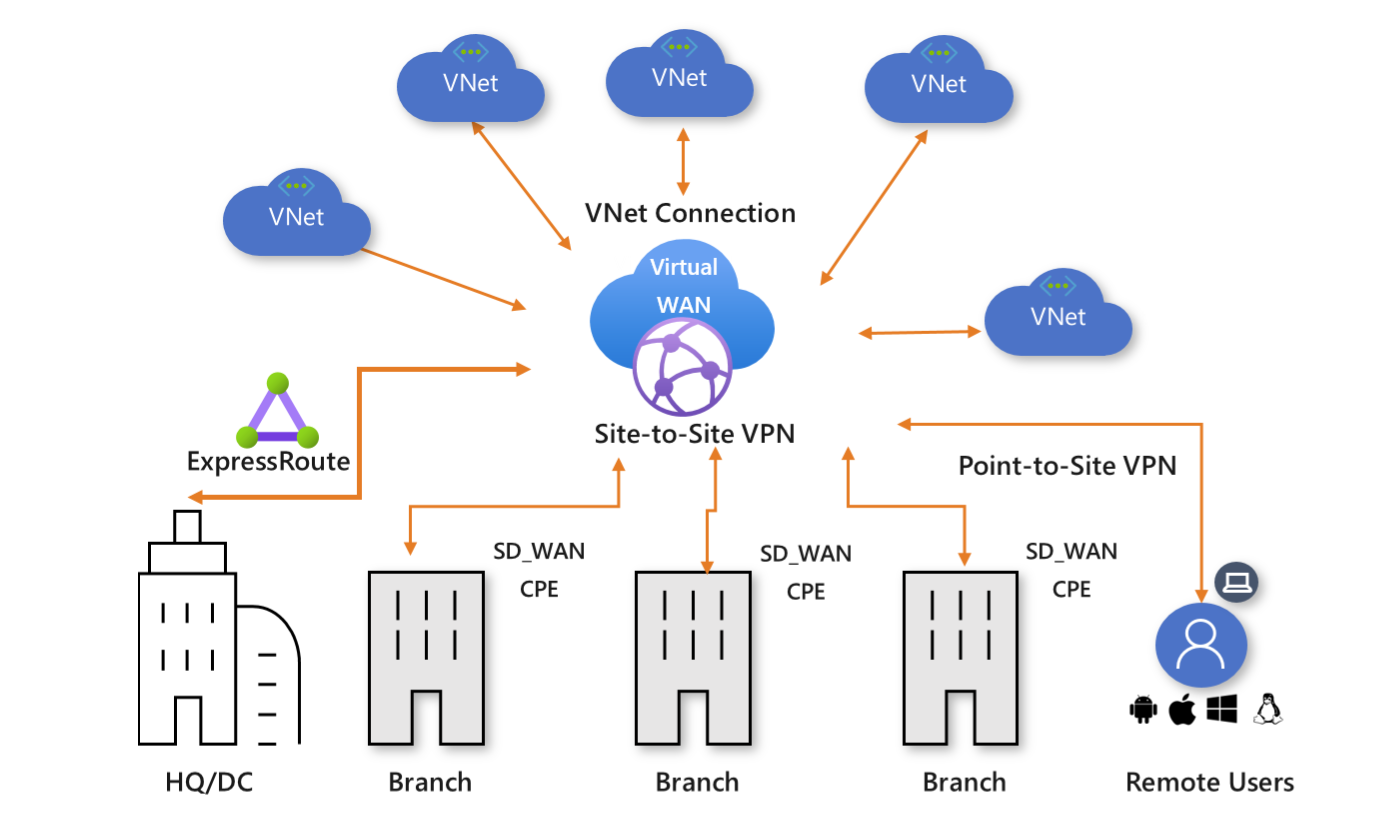
Azure Virtual WAN is still a hub-and-spoke architecture, but with a critical distinction: Microsoft manages the hub infrastructure, scaling, and routing.
Instead of deploying a custom VNet, you deploy a Virtual WAN resource containing virtual hubs across your active regions.
- Transitive Routing Natively: Virtual WAN provides transitive routing by default, meaning Spoke A can reach Spoke B through the virtual hub without any UDR configuration.
- Global Mesh: If you deploy hubs in multiple regions, they automatically establish hub-to-hub connectivity over the Microsoft backbone. Cross-region traffic flows without manual gateway or peering configurations.
The Game Changer: Routing Intent & Secured Virtual Hubs
The most powerful feature of modern vWAN is Routing Intent. If you deploy Azure Firewall inside the vWAN hub (creating a “Secured Virtual Hub”), Routing Intent eliminates manual route management entirely.
Routing intent abstracts routing decisions into two declarative categories: private and internet.
- Internet Traffic Policy: Automatically forwards all internet-bound traffic from connected VNets and branches to the hub’s security solution.
- Private Traffic Policy: Automatically forwards all inter-VNet, branch-to-VNet, and inter-hub traffic to the hub’s security solution for inspection.
Once configured, the vWAN control plane pushes these effective routes down to every connected spoke automatically—making UDR sprawl a thing of the past.
Architectural Comparison.
| Feature | Traditional Hub & Spoke | Azure Virtual WAN |
| Hub Infrastructure | Customer-managed VNet | Microsoft-managed Virtual Hub |
| Transitive Routing | No (Requires NVA/Firewall & UDRs) | Yes (Native) |
| Multi-Region Mesh | Manual hub-to-hub peering | Automatic global backbone mesh |
| Route Management | Manual UDRs per spoke/subnet | Automated via Routing Intent policies |
| Pricing Model | Standard compute & bandwidth | Unit-based (Deployment, Scale, & Routing units) |
| Troubleshooting Depth | Deep (Full packet-level access) | Abstracted (Relies on managed dashboards) |
When to Migrate: The Decision Matrix
Virtual WAN is a scale alternative to hub-spoke, not a replacement. The decision to migrate comes down to your three-year growth trajectory.
Stay with Traditional Hub & Spoke if:
- You operate in only one or two Azure regions.
- You have fewer than 30 spoke VNets.
- You require a highly custom third-party NVA that is not supported inside a vWAN hub.
Migrate to Azure Virtual WAN if:
- You are crossing the 3-Region threshold: The operational cost of manually synchronizing routes across three or more active regions rapidly exceeds the platform premium of vWAN.
- You have massive branch connectivity: vWAN was designed to ingest dozens or hundreds of branch offices via Site-to-Site VPN or SD-WAN partners (e.g., Cisco, VMware).
- Your network team is drowning in UDRs: If managing static routes is slowing down application deployments, vWAN’s Routing Intent provides the automation needed for DevOps agility.
Reference.
https://learn.microsoft.com/en-us/azure/virtual-wan/virtual-wan-about