Distributed Denial of Service (DDoS) attacks remain one of the most common and disruptive threats to modern cloud workloads. By flooding a public endpoint with malicious traffic, attackers look to exhaust infrastructure resources and knock critical applications offline.
For cloud architects deploying systems on Azure, understanding how Microsoft mitigates these threats is essential. This guide covers everything you need to know about Azure DDoS Protection, comparing its architectural tiers, out-of-the-box features, paid SKUs, and financial benefits.
The Three Pillars of Azure DDoS Defense
Microsoft structures its DDoS defenses across three distinct offerings, tailored to different budget footprints and technical requirements.
1. Azure DDoS Infrastructure Protection (Default & Free).
At no additional cost, Azure infrastructure protection safeguards every single Azure service that utilizes a public IPv4 or IPv6 address. This always-on monitoring runs natively at the Azure network edge, scrubbing massive volumetric layer-3 and layer-4 attacks before they can disrupt the global cloud ecosystem.
How it works: It uses massive platform-wide thresholds.
The catch: It is configured to protect the Azure platform as a whole, not your specific web server. If an attack is large enough to crash your individual VM but too small to register as a threat to Microsoft’s global network infrastructure, the free tier will not trigger adaptive mitigation for your app.
2. Azure DDoS Network Protection (The Enterprise Standard).
Enabled at the Virtual Network (VNet) level, Network Protection automatically protects all public IP resources mapped within that VNet.
Pricing: A fixed cost of $2,944/month, which includes coverage for up to 100 public IP addresses across your tenant.
Best for: Large enterprise environments, multi-region deployments, or architectures containing more than 15 public IP resources.
3. Azure DDoS IP Protection (The Targeted Sentinel).
Designed for smaller workloads, IP Protection delivers the exact same advanced technical scrubbing algorithms as Network Protection, but applies them to an individual public IP resource.
Pricing: A fixed cost of $199/month per protected public IP.
Best for: Small to mid-sized footprints containing fewer than 15 public IPs where paying the full enterprise tier flat rate isn’t economically justifiable.
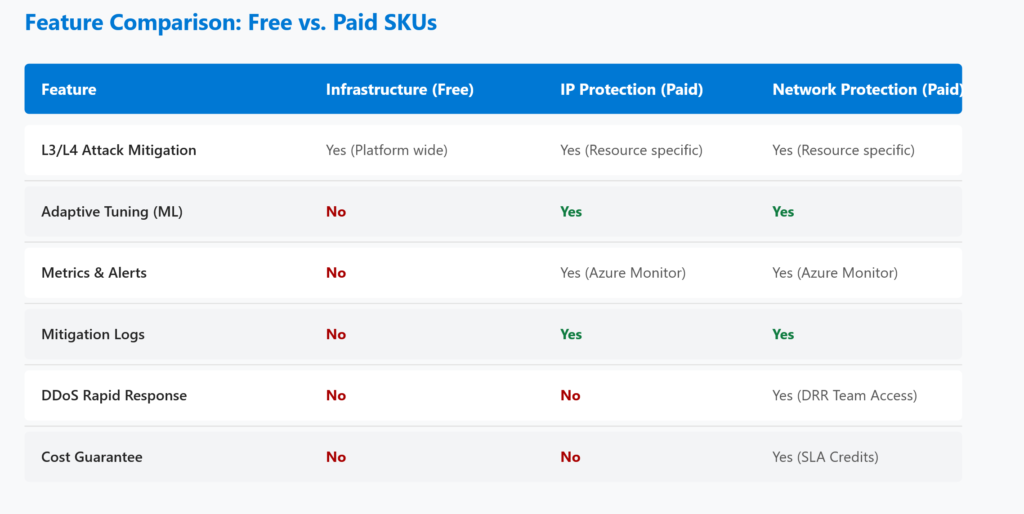
Feature Comparison: Free vs. Paid SKUs
To understand why enterprise systems upgrade to paid tiers, you must look at how thresholds are calculated:
Core Architectural Benefits of Paid Tiers
Adaptive Policy Tuning
Unlike standard static network firewalls, Azure’s premium tiers use machine learning to continuously monitor your application’s traffic baseline. If your application typically handles 500 requests per second, the system builds an adaptive rule profile matching that pattern. If a botnet suddenly spikes traffic to 50,000 requests per second, the mitigation rules lock down immediately to drop the malicious requests while passing legitimate user traffic.
Operational Cost Protection (Network Protection Only)
During a sustained volumetric attack, backend cloud resources automatically scale out to handle the massive traffic surge. Under standard conditions, this results in a devastating cloud bill.
With DDoS Network Protection, Microsoft provides financial protection. If your Azure Firewall, Application Gateway, or Virtual Machine Scale Sets are forced to automatically scale out to absorb an attack, Microsoft issues bill credits to cover those excessive infrastructure scaling costs once the attack validation concludes.
DDoS Rapid Response (DRR) Support
When an active attack occurs, enterprise teams utilizing Network Protection can directly engage the DDoS Rapid Response (DRR) engineering team. These specialized Microsoft security engineers assist with active threat diagnostics, custom configuration tuning, and post-attack forensics.
Which Azure Services Feature Out-of-the-Box "Free" Protection?
Every Azure resource associated with a Standard or Basic Public IP address benefits from baseline Infrastructure DDoS Protection at zero cost. This includes:
Azure Virtual Machines (with public network interface cards attached)
Public Load Balancers
Azure Firewall
Application Gateways
Azure DNS (Core PaaS layer)
Azure App Services (When assigned a public virtual IP)
The Architecture Limitation Note.
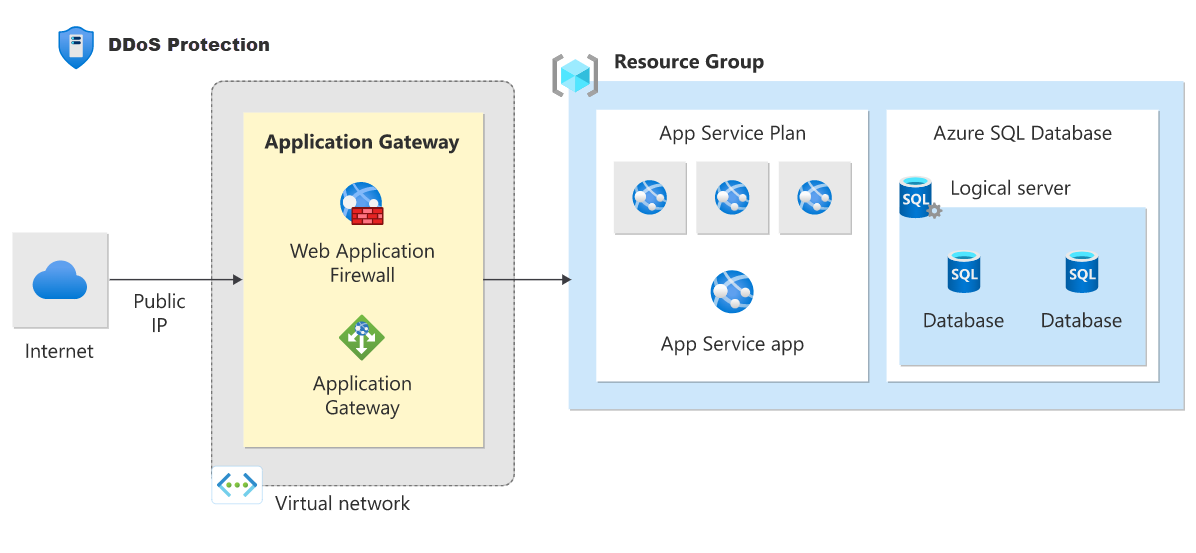
While these services are natively shielded from infrastructure-collapsing volumetric traffic, multitenant PaaS services (such as Azure Virtual WAN, API Management in standard configurations, or NAT Gateways) do not support the advanced, individualized adaptive rulesets provided by the paid IP and Network protection SKUs. To protect layer-7 web application vulnerabilities (like HTTP floods or SQL injections), you must pair your DDoS protection with an Azure Web Application Firewall (WAF).
Final Design Thoughts
Azure DDoS Protection is a premier example of building operational resilience directly into your network layer. For development environments, internal test beds, and basic standard websites, the built-in Infrastructure Protection is completely sufficient.
However, if you are running production-grade ecommerce architectures, critical financial applications, or massive scale workloads, the investment in IP Protection or Network Protection is non-negotiable. The addition of automated metric alert logging, custom machine learning profiles, and cost assurance policies turns a generic cloud environment into a highly resilient, enterprise-grade ecosystem.
References.
Microsoft Learn: Azure DDoS Protection SKU Tier Comparison Overview
Azure Pricing Guide: DDoS Cost Matrix and Licensing Thresholds