For the last several years, if you asked an Azure Architect how to secure a PaaS service like Storage, Key Vault, or SQL, the answer was always immediate and definitive: Disable public access and use a Private Endpoint.
Azure Private Link revolutionized cloud security by bringing PaaS services directly into your Virtual Network (VNet) via a private IP address. However, as enterprise architectures scaled, this “best practice” introduced a massive operational hangover: managing hundreds of Private Endpoints, complex Private DNS zones, IP exhaustion, and routing overhead.
To solve this, Microsoft introduced the Azure Network Security Perimeter (NSP).
But does NSP replace Private Endpoints, or is it a completely different tool? Let’s break down the architecture of both, why managing PaaS security is evolving, and when to use each.
The Status Quo: The Challenge with Private Endpoints at Scale.
Azure Private Endpoints create a dedicated network interface inside your VNet. If an Azure Virtual Machine or an on-premises server needs to talk to a Key Vault, the traffic never touches the public internet. While highly secure, Private Endpoints introduce significant administrative friction when scaled across an enterprise:
- DNS Sprawl: Every Private Endpoint requires DNS resolution to work correctly. You have to maintain
privatelink.blob.core.windows.net,privatelink.vaultcore.azure.net, and dozens of other zones. Misconfigure a DNS forwarder, and your entire application breaks. - PaaS-to-PaaS Friction: If an Azure Function (PaaS) needs to read from Azure Storage (PaaS), routing that traffic through a VNet using Private Endpoints requires VNet Integration, subnet delegation, and complex routing—even though both resources live natively in the Azure fabric.
- IP Exhaustion: Every Private Endpoint consumes an IP address from your subnet. In massive microservice environments, you burn through CIDR blocks rapidly.
The Paradigm Shift: What is Azure Network Security Perimeter (NSP)?
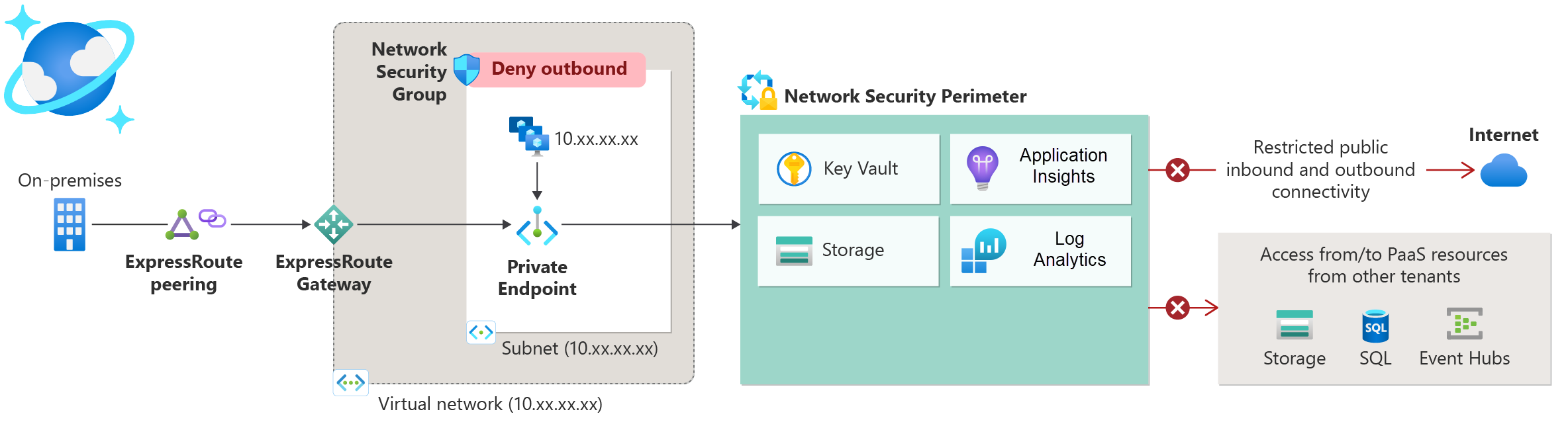
Instead of dragging PaaS resources down into a VNet, Azure Network Security Perimeter (NSP) creates a logical security boundary directly in the cloud fabric. NSP allows you to group related PaaS resources (e.g., a Cosmos DB, a Key Vault, and a Storage Account) into a single secure perimeter.
- Intra-Perimeter Trust: Resources associated with the same NSP can communicate with each other securely by default. No VNets, no subnets, and no DNS zones are required for them to talk.
- Centralized Access Rules: Instead of configuring firewalls on 50 different Storage accounts, you create inbound and outbound access rules at the NSP profile level.
- Data Exfiltration Protection: NSP prevents resources inside the perimeter from sending data to unauthorized external resources. If a compromised app tries to dump your Cosmos DB data to a rogue storage account outside the perimeter, NSP blocks it.
Architectural Comparison: NSP vs. Private Endpoints.
| Feature | Private Endpoints (Private Link) | Network Security Perimeter (NSP) |
| Primary Goal | Private network path (VNet isolation) | Centralized PaaS access & data exfiltration protection |
| Underlying Mechanism | Injects a Private IP (NIC) into a VNet | Logical boundary enforced at the Azure control plane |
| DNS Requirements | High (Requires Private DNS Zones) | None |
| PaaS-to-PaaS Comm. | Complex (Requires VNet integration & routing) | Seamless (Intra-perimeter traffic is allowed natively) |
| Access Management | Decentralized (Managed per resource) | Centralized (Managed via NSP Profiles & Access Rules) |
Better Together: It’s Not an “Either/Or”.
A common misconception is that NSP replaces Private Link. In reality, they are highly complementary.
The best-in-class architecture for modern enterprise Azure environments uses both:
- Use Private Endpoints for IaaS-to-PaaS (The Bridge): If you have users sitting in a corporate office on an ExpressRoute, or legacy VMs running in a VNet, you still need a Private Endpoint to bridge your private network space to the PaaS resource. Private Endpoints are the definitive answer for private connectivity.
- Use NSP for PaaS-to-PaaS (The Fortress): Group your backend PaaS resources into a Network Security Perimeter. Let your Event Hubs, Azure AI Search, and SQL Databases communicate natively within the perimeter without the overhead of DNS and subnet routing. You use NSP for resource-centric security and exfiltration prevention.
The Verdict.
If you are building a modern, cloud-native application primarily utilizing PaaS and serverless architecture, Azure Network Security Perimeter is the governance tool you have been waiting for. It allows you to strip away the complex network plumbing of VNets and DNS, while actually increasing your security posture against data exfiltration.
Stop managing individual firewall rules and IP addresses. Start managing perimeters.